Home Office Chairs
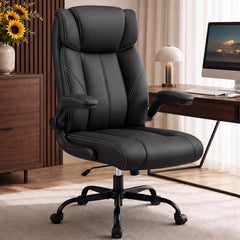
An office chair is a set of adjustments, and a chair without them will not fit a body. Seat height should span at least 18 to 21 inches so feet land flat with the desk at elbow height; a seat slider adds 2 inches of depth range; the lumbar support should move up and down rather than sit as a fixed pad. Tilt tension and a tilt lock are separate controls, and a rocking recline that stops at 135 degrees is what lets a chair carry you through a long afternoon without numbing the legs.
Weight ratings separate the classes. Standard task chairs rate 250 to 300 pounds; big-and-tall executive chairs go to 450 pounds with a wider seat pan and a heavier class-4 gas cylinder. Flip-up arms are the detail that lets a chair roll fully under a desk or a keyboard tray without the armrests catching the edge.
Leather wipes clean but traps heat; mesh breathes but collects dust in the weave. Vacuum the seat and back monthly, check the caster threads and the cylinder collar each season, and never lubricate a gas cylinder.